A fast, modern macOS terminal with true bidirectional rendering — Hebrew and English live on the same line, in the right order, every time.
✓ Signed & notarized by Apple · ✓ opens with no Gatekeeper warning
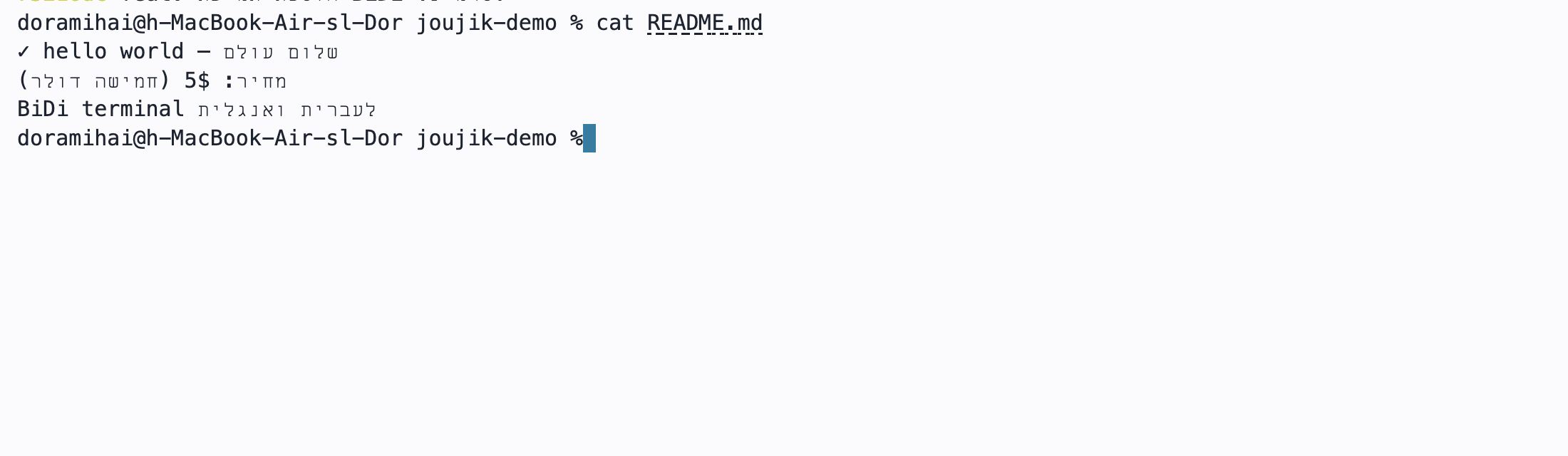
Every other terminal mangles mixed Hebrew–English text: letters flip, brackets mirror the wrong way, your cursor lands in the wrong place. Joujik Terminal renders each line in correct visual order using the Unicode bidirectional algorithm — while keeping copy, paste and selection in true logical order, so what you paste is what the shell meant.
Under the hood it's a real terminal: it runs your own zsh / bash, speaks full ANSI/VT, and adds the things you actually use every day — tabs, split panes, search, themes and automatic session restore.
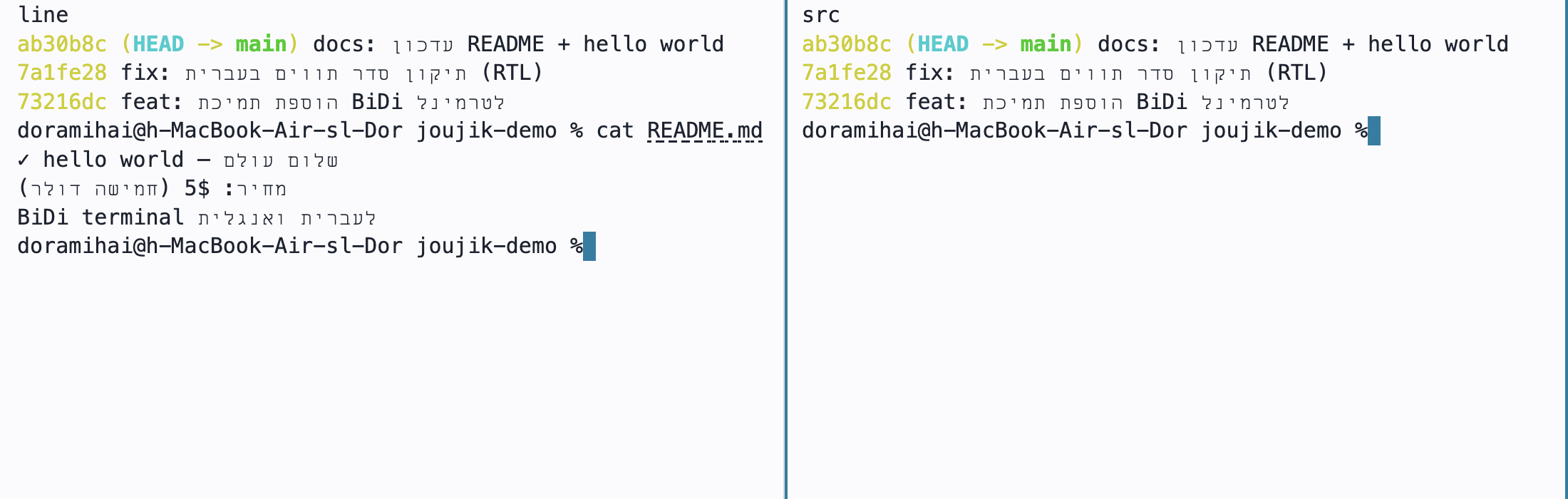
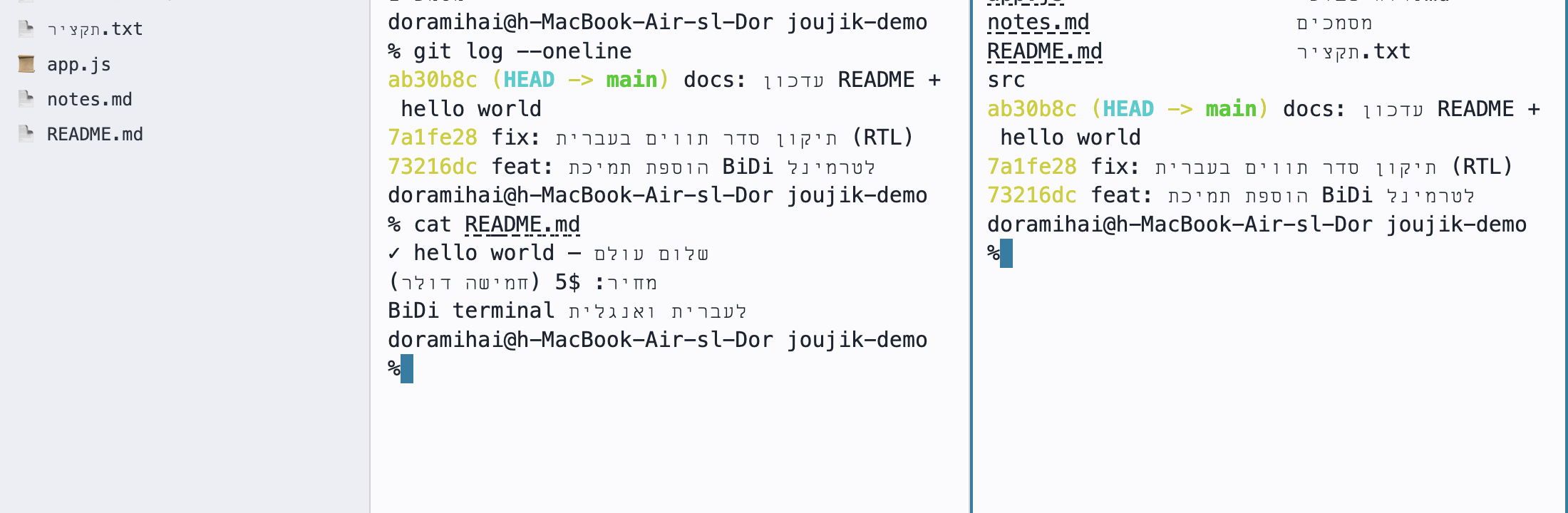
Actual screenshots — filenames, git history and output in mixed Hebrew & English.


Real features, all implemented — not a wish-list.
Mixed Hebrew & English on one line, ordered correctly with bracket mirroring. Toggle it on or off instantly.
Vowel-pointed (niqqud) Hebrew from TUIs like Claude Code stays whole — words no longer shatter into scattered letters. One keystroke, on or off.
Open as many terminals as you like, switch with ⌘1–9, rename any tab with a double-click.
Split side-by-side or stacked to run commands in parallel. Layout is restored when you reopen.
Save a whole tab layout — splits and the working directory of each pane — and bring it back by name.
Browse folders without leaving the shell. Double-click to insert a path, “Go” to cd the active pane.
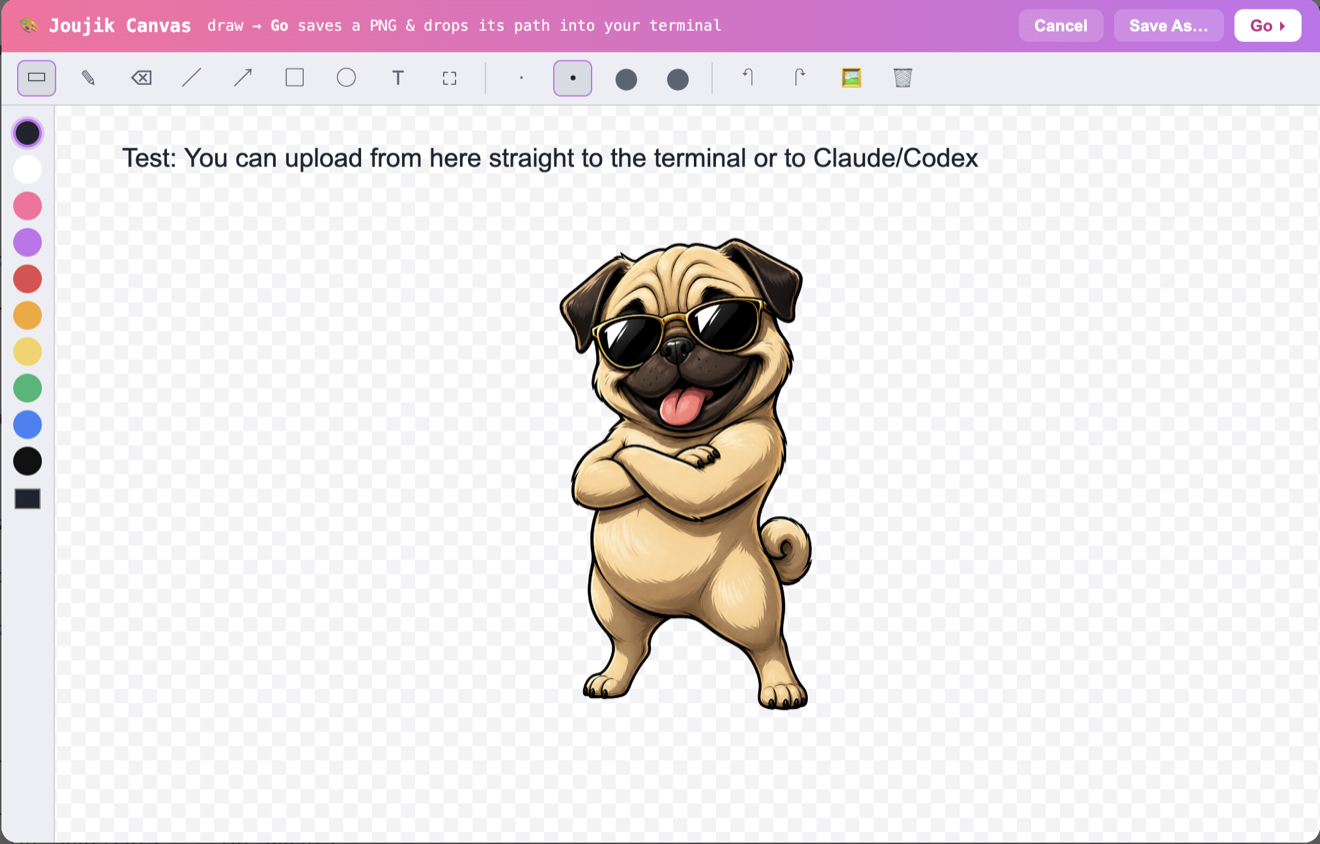
Sketch a diagram or annotate a pasted screenshot, then press Go — it saves a PNG and drops the file’s path into your command line, ready to use. Fully local, no network.
Find anything in your history with live match count and jump-to-match navigation.
Fuzzy-search your shell history, newest first, and insert a command without auto-running it.
⌘-click any URL to open it in your browser, or any file path to open it with the default app.
Click to place the cursor, drag to select, double/triple-click for word and line, trackpad scrolling.
Save your session as plain text, Markdown, or styled HTML — Hebrew and colors preserved.
Five built-in themes and ⌘+ / ⌘− font zoom; your choice persists across launches.
Reopen to exactly where you left off; recover a stuck pane without losing your work.
Type a commit message, a path, a string literal — half Hebrew, half English. Joujik Terminal puts every glyph exactly where it belongs.
Everything below just landed: a Paint-level canvas, a session history that remembers your AI prompts, shortcuts that work in any keyboard layout, a full mouse inside AI tools — and the same terminal, now on Windows.
Paste screenshots and move, resize and re-order them like layers; bring objects front or back; double-click any text to edit it; erase or Backspace to delete. Press Go and the PNG’s path drops into your shell — perfect for handing an image to Claude Code.
Your command palette now records everything you type in that terminal — including the prompts you write inside Claude Code — so a long prompt is never lost. Per-terminal, in-memory, and passwords are never captured.
⌘C, ⌘V, ⌘T, Ctrl-C and the rest now fire even while your keyboard is set to Hebrew — matched by the physical key, not the letter it types.
Hold ⇧ Shift and drag to select text out of a full-screen app like Claude Code, right-click for Copy/Paste, and drag / right-click reach TUIs like tmux and vim.
The same true-BiDi terminal for Windows 10/11 — canvas, session history, BiDi rendering and Hebrew-layout shortcuts included. Shortcuts use Ctrl+Shift.
Image paste from Finder drops the real file path, repeated right-clicks stay calm, exports report errors clearly, and closing a busy window no longer stalls.
Some TUIs — Claude Code among them — miscount the width of Hebrew niqqud and scatter the letters across the line. Every terminal renders it broken, even Apple Terminal. Nikud mode puts the words back together, live.


Most terminals treat the mouse as an afterthought. In Joujik it's first-class — select, delete and reposition with the pointer, even across wrapped lines and in mixed Hebrew/English.


Joujik runs your real shell. Your zsh config, plugins, aliases and prompt work exactly as you set them up — nothing is intercepted or reimplemented.
Some terminals (Warp) replace your shell's line editor with their own — so clicking anywhere always works, but you lose your real zsh, your plugins and your live prompt. Others inject fragile scripts that break custom prompts on the next update. We chose neither.
> continuation). A niche case — not worth breaking your shell for.A compact status bar at the bottom puts every action one click — or one shortcut — away.
Open a fresh terminal in your home directory.
Show / hide the folder sidebar; “Go” changes the active pane's directory.
Searchable palette of your shell history — insert without running.
Add a pane to the right of the current one.
Add a pane below the current one.
Open a file picker and drop the chosen path into the input line.
Open a drawing overlay; “Go” saves a PNG and inserts its path into the terminal — no network, all local.
Save the buffer as .txt, .md, or styled .html.
Save the current tab layout by name and restore it later.
Cycle through dark, light, Solarized, Dracula and Nord.
Turn bidirectional Hebrew/Arabic reordering on or off.
Send Ctrl-C and redraw — unstick a frozen pane without losing the session.
Open the full keyboard-shortcut reference, grouped by category.
Switch with the 🌓 button — your choice is remembered next time you open the app.
Apple Silicon (M1 or newer)
Apple-verified — opens with no Gatekeeper warning
A single download — no install wizard, no dependencies
Runs your local shell — zero network calls, no telemetry
Pay securely and get your license key and download instantly.
Questions? Email service@joujik.com · instant download & license key after purchase.